


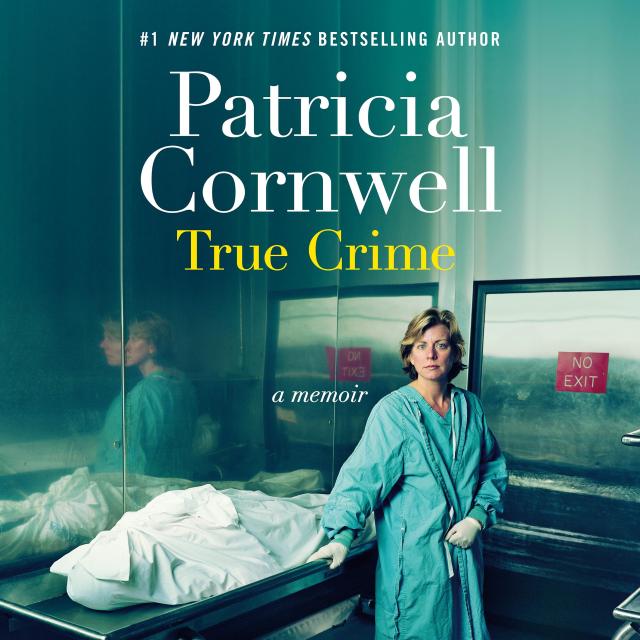
True Crime
A Memoir
Contributors
Read by Patricia Cornwell
Formats and Prices
- On Sale
- May 5, 2026
- Publisher
- Hachette Audio
- ISBN-13
- 9781668655658
Price
$31.99Format
Format:
- Audiobook Download (Unabridged) $31.99
- ebook $14.99 $19.99 CAD
- Hardcover $32.50 $42.00 CAD
- Trade Paperback (Large Print) $32.00 $42.00 CAD
Buy from Other Retailers:
#1 New York Times bestselling author Patricia Cornwell finally tells the story that rivals all of the works that precede it: her own.
Patricia Cornwell is best known for her international bestselling thriller series about forensic pathologist Dr. Kay Scarpetta. Every story comes from somewhere, and Scarpetta’s began when Patricia Cornwell embedded herself in a morgue.
In this achingly honest memoir, Cornwell excavates her own life, detailing her traumatic childhood being raised by neglectful parents, her father abandoning the young family on Christmas day, her mother being institutionalized twice, an abusive foster family, and developing a parental relationship with evangelist Billy Graham’s wife Ruth. Cornwell depicts a harrowing hospitalization and near-death car accident. She unflinchingly shares overcoming obstacles that later gave her the ambition to become an award-winning police reporter. From there it was research in a medical examiner’s office that would turn into a full-time job. She would become a forensic expert and worldwide publishing phenomenon.
Cornwell leaves no stone unturned in this deeply candid account of her life, offering inspiring insight into what made her into the international sensation she is today.
You May Also Like
PREVIEW AN EXCERPT
WHAT DROVE ME TO IT
Over the years I’ve been asked when I plan to write a memoir. I’ve said never. It’s my obsessive nature to move forward full speed without looking back. But as has been true of most important projects, this one picked me rather than the other way around.
In recent years there have been discussions about a TV series based on my life. The focus would be my intense research and tendency to get involved in real murder investigations. When I read the first draft of the outline and then the pilot, I didn’t recognize myself. This wasn’t anybody’s fault. Until now there’s been no accurate and full accounting of my personal background and career.
At the end of 2024, I was five months early turning in my twenty-ninth Scarpetta novel, Sharp Force. I don’t know how that happened. But some plots uncoil faster than others, the characters more cooperative than usual. Suddenly, I had time on my hands and decided to draft an autobiographical treatment for the proposed TV show. If it were made, the details I supplied would be helpful to the writers.
Getting started, I was frustrated immediately. I hate composing pitches, summaries, master plots, and resist talking about something instead of writing it. I won’t do outlines unless it’s after the fact. In college, I always created them and the index cards last. I’d rather jump straight into the term paper, essay, or story. Within days of working on the treatment, I quit and began writing this memoir.
It wouldn’t have been possible were it not for my sister-in-law Mary. She’s been my archivist for more than twenty years, and has helped me research my life. This memoir isn’t as much about me as everyone else who’s had a starring role in my saga, most of all my brothers, Jim and John.
When we were growing up, they blocked out distressing episodes. But I don’t have that special talent. Now that so many people are gone, including my parents, my former husband, Charlie Cornwell, and others instrumental in my life, it’s important to tell what I remember. For some reason, I don’t forget drama, fantastic or awful.
Extreme emotions capture scenes the way light etches images on a photographic negative. I can envision what people looked like, what they were wearing, sometimes what they said, and most of all what I felt about them. This is a helpful quality for a writer, and a way of fixing programming errors.
I believe that life is a series of self-corrections if we’re willing to make them, and we don’t always understand what’s going on while it’s happening. Often what I experience, research, and imagine is intended for the future. The best example is my first full-length book. I began it the summer of 1976 when I’d just turned twenty and was transferring to Davidson College in North Carolina.
The so-called novel is a detailed recounting of my first nineteen years. I think of it as a naïve and amateurish Portrait of the Artist as a Young Man. Only in this case the author was a young woman who’d never heard of James Joyce or much else considered literature. I wasn’t well read and never will be.
Over the summer of 1976, I’d mail installments of my writing to Davidson English professor Charlie Lloyd. An eccentric genius, he knew more about Shakespeare than any mortal and had taught himself seven languages. But he refused to get a Ph.D. When the frustrated Davidson president Sam Spencer demanded to know why, Charlie Lloyd famously answered, “Who would examine me?”
Mr. Lloyd, as I called him, became my mentor before I arrived on the Davidson campus in late August. He was incredibly generous to a largely illiterate stranger, his appraisals honest but kind. At that time, I was writing in fractured sentences, ignoring rules while exploring how to create scenes without words, punctuation, and structure getting in the way.
Mr. Lloyd commented that my staccato style was jolting and annoying. Remotely, he was tutoring me, answering every time I wrote. While at Davidson, I often was at his home, where he introduced me to sputtered eggs that he scrambled with cream and butter. I’d leave bottles of his favorite beer, St. Pauli Girl, in the pigeonhole where he got his interoffice mail.
I spent most of my spare time at Davidson working on various drafts of my book. From the start it was an autobiography that I paraded as fiction. With rare exception, the only thing I made up were the characters’ names. The title of my first draft was The Man with the Golden Key, an allusion to the George MacDonald fairy tale about a boy who finds a golden key at the end of a rainbow. But what does it unlock? He must discover that next.
The eventual title of my book was Forum, as in the ancient Roman Forum, the site of legal trials. Ironically, forum is where the word forensic comes from. The root of it is the Latin word forensis or of the forum. Specifically, forensic refers to matters of interest to the courts, and that’s the point of forensic science and medicine. I didn’t know this when I was in college.
Ultimately, my book was three hundred pages long, composed on a pawnshop manual Royal typewriter. With each draft, I’d recycle the paper of the previous one, using the backs of pages for something else. After the final manuscript was done my senior year, I never looked at it again until half a century later.
Without that early effort, and journals I’ve kept throughout my life, I couldn’t have pieced together my past. Many of the vivid details I knew at the time I wouldn’t remember now. This memoir has been part of the master plan all along. Only I didn’t know it.
I wish I could time travel and tell my young self not to be discouraged. I imagine her typing away as if possessed while her classmates participated in extracurricular activities and partied. I would whisper to young Patsy Daniels that things would turn out far better than she dreamed. Don’t despair and never quit.
You’ll be shocked to find out what your future holds, I’d confide. Most of it magical and wonderful. And the rest you will survive.
I didn’t grow up wanting to be an author. It wouldn’t have occurred to me that one day I’d be known for graphic thrillers that read like true crime. But the foreshadowing was there early on. By the age of nine I was telling scary stories that made the neighborhood children cry and run home. I’d feel chagrined, a touch remorseful, but not for long. They always came back for more.
I can’t abide violence, which is why I feel compelled to write about it. I hate to think about anything being killed. That’s not to say I haven’t taken a few lives, mostly during my early years. Fish. Crabs. Bugs. During a brief but shameful period, I collected butterflies, writing a poem about it that I titled “Murder in the Lilacs.” I went dove hunting once and am sorry for all of it.
People assume I enjoy spending time in morgues, and at the scenes of murders, suicides, and violent accidents. It must be a thrill talking to serial killers on death row. Obviously, I think it’s the coolest thing to see an autopsy. How amazing to watch a dead body shoved into a crematorium oven. Or to witness an execution.
I find most of my research all but unbearable. I endure it because I must if I’m to tell the truth in my stories, whether nonfiction or imagined. To witness gore and suffering is fascinating while indescribably awful, and I pay a high price. Disaster and violence await around every corner. Wherever I am, I spot something potentially fatal.
An escalator can cut you to ribbons if you’re not paying attention. The scaffolding you foolishly walked under could collapse. The backhoe gouging the earth on the roadside is way too close to cars going past. The person loitering suspiciously might be a serial killer. If I’m not careful I’ll imagine the scenario to its gruesome conclusion while making sure everybody else does too.
One might suppose that my exposure to virtually any horror you can think of would have made me insensitive. I’d be impervious. It’s the opposite, as if I have no emotional skin left as a barrier. I get upset, even teary, when I see cruelty. I switch the channel when an animal rescue commercial comes on.
I’m squeamish and can’t watch scary or depressing movies. I avert my gaze during gory scenes or get up and leave the room. I avoid shows like Grey’s Anatomy while eating dinner. I have a list of food associations that are best left unmentioned. But I will anyway. Topping the list are beef liver, steak tartare, and borscht.
I became a published author for the first time at the young age of twenty-eight, but nothing about my career has been easy. This is one of many reasons I tell people, especially artists, not to give up. If anybody’s had good reason to on countless occasions, it’s me. My early life was a string of failures. I was convinced I’d never amount to a thing. I would die young, possibly by my own hand.
If nothing else, this story is my way of encouraging others never to stop trying, and to take a big swing at life. Like that flawed book I wrote in college, there are reasons for what happens, and we may not know them until much later. In January 2025 as I began sifting through the manuscript of Forum, I felt as if Patsy Daniels and Patricia Cornwell finally found each other. Patsy was helping with my story, and I was helping with hers.
On August 29, 1977, the beginning of my junior year in college, I noted in my journal:
The first draft of my novel is finished. I wonder if my gut rending effort will be destined to rest in a dusty box on a closet shelf. If so, I can only say that I would have written it anyway.